
A concept for a giant radio telescope in a crater on the Moon has been proposed at the Jet Propulsion Laboratory in California. The Lunar Crater Radio Telescope (LCRT) project is receiving initial funding by NASA’s Innovative Advanced Concepts Program. The idea is to construct the telescope on the far side of the Moon, using a nearly hemispherical crater in which to deploy a metal mesh receiver dish. This will require a crater with a suitable depth and a diameter of 3-5 km, although the actual receiver dish will measure 1 km across. If completed, it will be the largest radio telescope aperture ever built [1], [2].

Credit: Saptarshi Bandyopadhyay (JPL) [1]
A telescope like this will have significant advantages over Earth or Earth orbiting space telescopes. The Moon acts as a massive physical barrier that shields the telescope from radio interference coming from Earth. Moreover, it could observe ultra-long wavelengths (5 – 100 m or the 3 – 60MHz frequency band) which were previously inaccessible as they are reflected by charged particles in the Earth’s ionosphere. Looking at these new wavelengths from the early universe could produce quite a lot of discoveries in cosmology [1], [2]. It is also possible that SETI might benefit from such a powerful telescope in searching for intelligent extraterrestrial life.
Unmanned spacecraft containing all the necessary equipment will have to be sent to the far side of the Moon, where one section would have to land in the crater’s centre, while multiple other sections will land along the edge. First, the landers on the edge will need to anchor themselves securely and descend into the crater towards the central lander to deploy strong guide wires. These wires will be attached to the central section after which the landers climb back up to their original positions. From the central section, a folded metal mesh is extended along the guide wires, pulled up by the landers along the circumference. The radio receiver that needs to be at the focal point of the dish is hoisted into position in the same way, except its guide cables are made much shorter and not attached to the central lander. This means it ends up above the bottom of the dish. Radio waves arriving at the crater are reflected by the metal lattice structure and focused into the receiver, much like how a television satellite dish works.
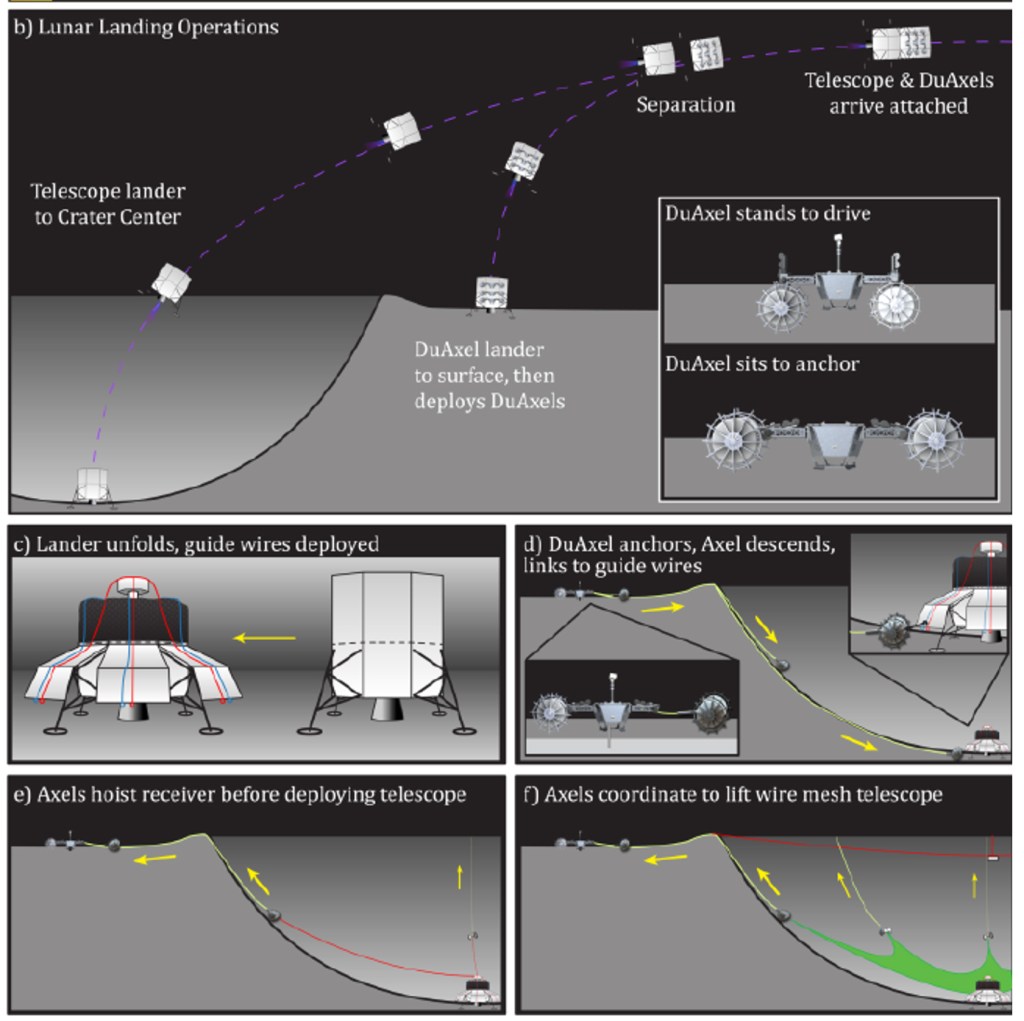
Credit: Saptarshi Bandyopadhyay (JPL) [1]
Needless to say, this is a very complex procedure with a lot of steps that could potentially go wrong. There is no direct radio contact with Earth on the far side of the Moon, therefore a satellite would need to be placed at a Lagrangian point ‘L2’ (where there’s no net gravitational effect) to relay signals to and from the Lunar surface [4]. There will be a communications delay of about 2 seconds each way, compared to 1.3 seconds for a direct Earth-Moon signal. Navigation and the controlled descent to the chosen crater could be done through radar as the spacecraft’s response must be fast if it needs to correct its course. To select the best possible crater in the first place, detailed images from the Lunar Reconnaissance Rover will be vital.
Astronauts on the Apollo missions discovered that Lunar soil (regolith) is a very fine, sharp dust that would get into small gaps in any equipment or even space suits, causing friction and jams. All of the deployment mechanisms must be resistant to dust. The robotics must be highly reliable, otherwise there is a risk of millions of dollars’ worth of equipment being consigned to Moon-junk.
Despite the technical challenges, NASA has experience sending robotic rovers to other planets and operating them remotely from Earth, such as the Curiosity Rover that landed on Mars in August 2012 or the Spirit and Opportunity Mars rovers that landed in 2004. Therefore, the idea of robotic landers operating autonomously while responding to their environment on the Moon isn’t far-fetched since it has been done before, at a much greater distance from Earth.
References
[1] “Lunar Crater Radio Telescope (LCRT) on the Far-Side of the Moon”, NASA, 2020. [Online]. Available: https://www.nasa.gov/directorates/spacetech/niac/2020_Phase_I_Phase_II/lunar_crater_radio_telescope/. [Accessed: 10- Apr- 2020].
[2] “Conceptual ideas for radio telescope on the far side of the moon – IEEE Conference Publication”, Ieeexplore.ieee.org, 2020. [Online]. Available: https://ieeexplore.ieee.org/document/8396801. [Accessed: 15- Apr- 2020].
[3] V. Tangermann, “NASA funds giant radio telescope concept on far side of Moon”, Futurism, 2020. [Online]. Available: https://futurism.com/nasa-radio-telescope-far-side-moon. [Accessed: 15- Apr- 2020].
[4] E. Howell, “Lagrange Points: Parking Places in Space”, Space.com, 2020. [Online]. Available: https://www.space.com/30302-lagrange-points.html. [Accessed: 17- Apr- 2020].
 Constantine's Notes